Part 4 — AI-Ready Healthcare Data Architecture
- Alex Frketic
- May 26
- 3 min read

As the RxNorm integration framework matured, one of the most important realizations was that the project was no longer simply an interoperability solution. It had evolved into the foundation for AI-ready healthcare data architecture. In many ways, the success of artificial intelligence within healthcare depends far less on advanced algorithms than it does on the quality, consistency, and structure of the underlying data. Before predictive models, machine learning systems, or intelligent automation can operate effectively, healthcare organizations must first establish trusted and standardized data ecosystems.
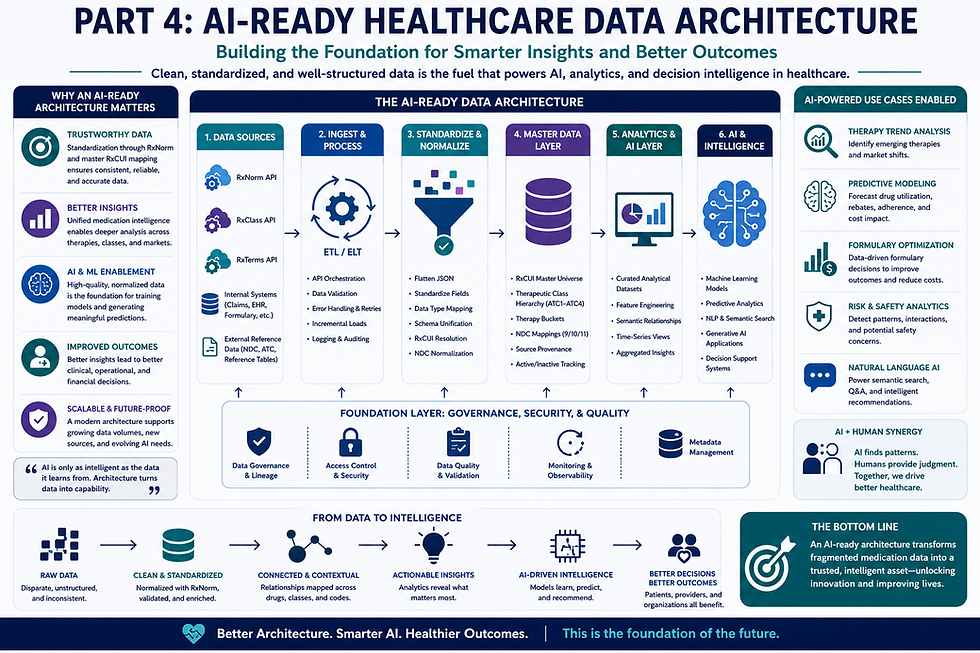
This concept is particularly important within medication analytics. Clinical drug information exists across countless systems, vendors, claims platforms, electronic health records, and pharmacy benefit managers. Without normalization, AI systems inherit fragmented data structures that produce inconsistent outputs and unreliable predictions. Clean architecture therefore becomes one of the most important prerequisites for responsible AI implementation in healthcare.
Throughout this project, the architecture decisions surrounding RxNorm, RxClass, and therapeutic mappings were intentionally designed to support future analytical scalability. Rather than focusing solely on immediate reporting needs, the framework was engineered to function as a reusable healthcare intelligence layer capable of supporting predictive analytics, advanced reporting, automation, and AI-driven initiatives in the future.
One of the foundational architectural principles involved creating standardized relationships between medications, therapeutic classes, and normalized identifiers. By anchoring the system around RxCUIs, the framework established a consistent language capable of connecting disparate systems together. This standardization is essential for artificial intelligence because AI systems rely heavily on consistency when identifying patterns, learning relationships, and generating reliable outputs.
Another major component of AI-ready architecture involves data lineage and traceability. In healthcare environments, organizations must understand where data originated, how it was transformed, and how analytical outputs were generated. This project reinforced the importance of designing pipelines that preserve source transparency while maintaining normalized analytical structures. Strong lineage practices help improve trust, governance, auditing, and long-term maintainability.
Scalable healthcare intelligence also requires architecture capable of supporting large analytical workloads. During development, the pipeline evolved beyond simple API retrieval and became a structured orchestration framework capable of handling large-scale processing, normalization, enrichment, and export procedures. The modular nature of the pipeline created opportunities for future integration into cloud systems, enterprise analytics environments, and machine learning workflows.
An especially important lesson involved understanding that AI systems are only as effective as the infrastructure supporting them. Organizations often focus heavily on model development while underestimating the engineering effort required to prepare healthcare data properly. In reality, much of the most important work occurs before AI models are ever introduced. Data normalization, interoperability, schema consistency, quality validation, and relational mapping form the true foundation of successful healthcare AI ecosystems.
The project also demonstrated how healthcare architecture must balance intelligence with responsibility. Unlike many industries, healthcare analytics directly impacts patient care, operational decisions, and financial outcomes. Because of this, AI-ready architecture cannot simply prioritize speed or automation. It must also emphasize governance, explainability, transparency, and data integrity. Building trustworthy healthcare systems requires infrastructure designed to support responsible decision-making rather than uncontrolled automation.
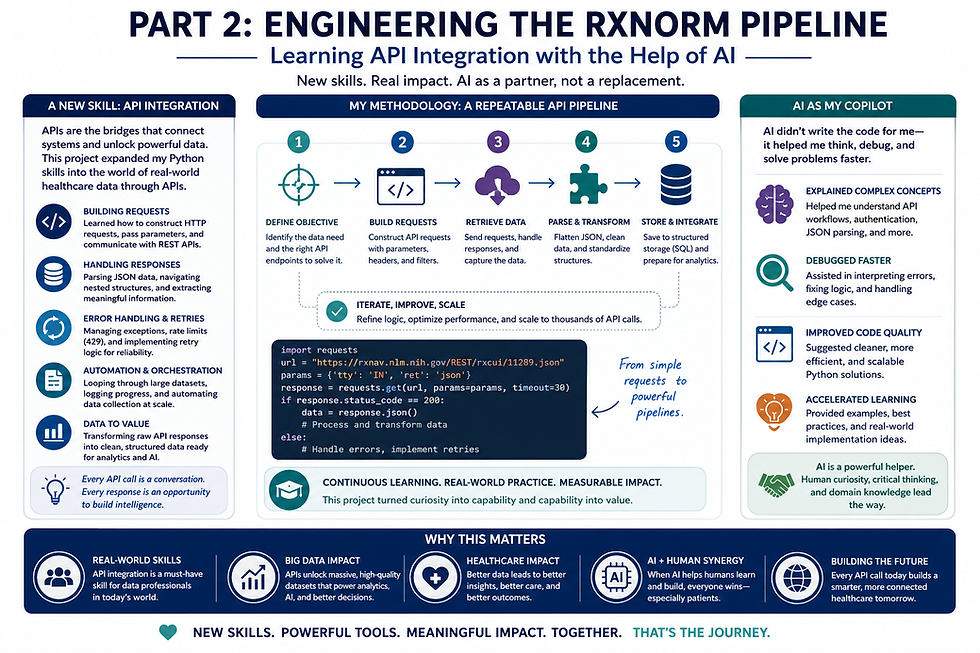
Artificial intelligence also played an important role throughout the development process itself. AI-assisted learning accelerated my ability to understand API workflows, optimize Python logic, troubleshoot integration issues, and explore architectural alternatives more efficiently. However, this experience consistently reinforced one of my core beliefs: AI works best when it helps people become more capable, not when it attempts to replace them entirely. Human oversight, domain expertise, and engineering judgment remained essential throughout every stage of development.
Ultimately, AI-ready healthcare architecture is not defined solely by advanced models or intelligent software. It is defined by the quality of the underlying engineering foundation. Clean data, scalable pipelines, normalized relationships, strong governance, and resilient interoperability frameworks are what allow intelligent systems to function effectively at enterprise scale. The RxNorm integration project demonstrated how thoughtful data architecture can become the backbone for future healthcare innovation.
Most importantly, this phase of the project reinforced the broader philosophy that continues guiding my work within healthcare analytics. The future of AI in healthcare is not about replacing clinicians, analysts, or healthcare professionals. The future lies in building intelligent systems that help people make faster, safer, and more informed decisions. Better architecture creates better intelligence, and better intelligence ultimately leads to better healthcare outcomes.


Comments