Part 5 — Enterprise Scaling + Future Vision
- Alex Frketic
- May 27
- 3 min read


As the RxNorm integration framework continued evolving, the project increasingly shifted from a technical proof-of-concept into an enterprise scalability discussion. Building a system that functions successfully in a controlled environment is only one stage of engineering maturity. The far greater challenge involves designing architecture capable of supporting long-term operational growth, expanding data volumes, organizational governance requirements, and future analytical innovation.
One of the most important lessons learned throughout this project was that scalability is not simply about processing more data. Enterprise scaling requires resilience, repeatability, maintainability, and adaptability. A scalable healthcare pipeline must continue operating reliably even as APIs evolve, business requirements change, datasets expand, and downstream systems become increasingly interconnected.
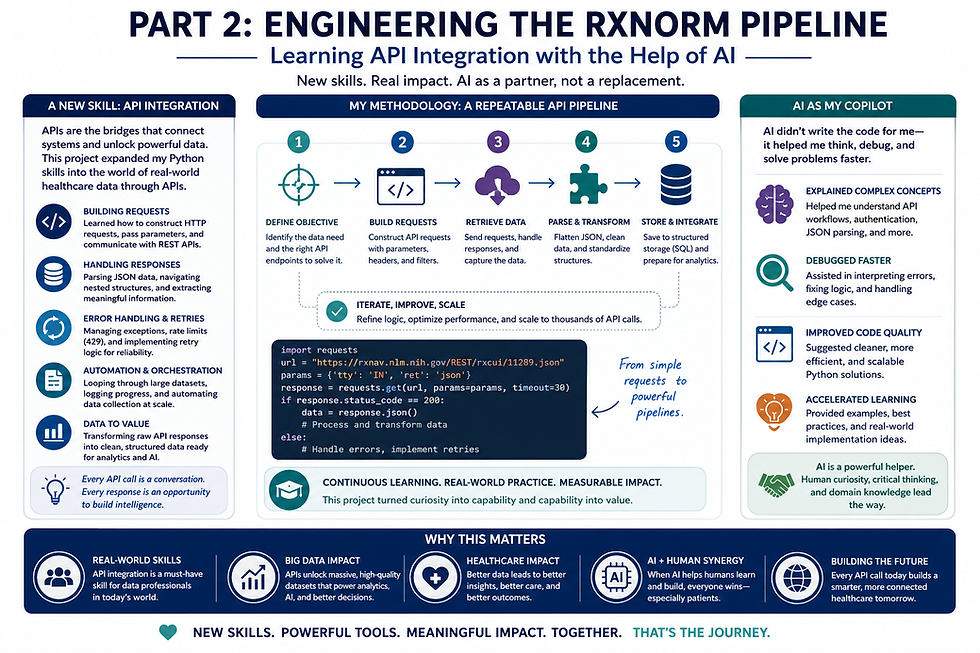
Throughout development, multiple architectural enhancements were introduced specifically to support enterprise-scale operations. Retry frameworks, status logging, error categorization, checkpoint processing, modular orchestration, and incremental refresh logic all became essential components of the final pipeline design. These features transformed the project from a collection of scripts into a more resilient engineering ecosystem capable of handling real-world operational complexity.
One particularly important area of focus involved operational governance. Enterprise healthcare environments require far more than successful code execution. Systems must support auditability, traceability, validation procedures, and reproducibility standards. Because of this, the framework evolved to incorporate structured logging, QA checkpoints, schema validation controls, and environment separation strategies capable of supporting long-term production stability.
Another major scalability consideration involved performance optimization. As healthcare datasets continue growing exponentially, engineering systems must process increasingly large workloads efficiently. During this project, performance engineering became a recurring priority involving retry optimization, caching strategies, batching methodologies, adaptive throttling controls, and improved SQL export structures. These decisions helped create a pipeline capable of scaling more effectively while maintaining stability and analytical consistency.
Future enterprise implementations could extend this architecture significantly further. One potential direction involves migrating the orchestration framework into cloud-native environments capable of supporting distributed processing, automated scheduling, and containerized deployment strategies. Another opportunity involves integrating real-time API ingestion patterns that continuously synchronize medication intelligence across multiple healthcare platforms.
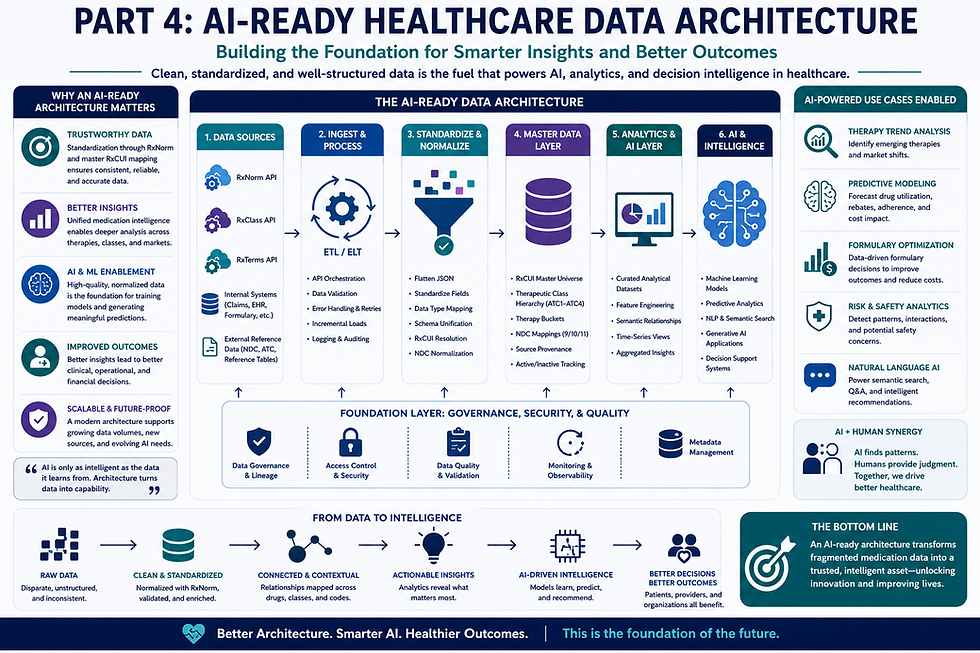
The future vision for this architecture also includes deeper integration with artificial intelligence and machine learning systems. Once medication data becomes standardized, normalized, and scalable, organizations can begin leveraging predictive analytics, therapy trend analysis, formulary optimization, utilization forecasting, and intelligent clinical decision support systems at far greater levels of sophistication.
Another exciting future opportunity involves semantic healthcare intelligence. Traditional healthcare analytics often relies heavily on structured relational systems. However, emerging technologies involving graph databases, vector embeddings, semantic search, and large language models may create entirely new ways of understanding medication relationships, therapeutic patterns, and clinical intelligence. Standardized RxNorm infrastructure creates a strong foundation for exploring these next-generation analytical capabilities.
The project also reinforced how critical interoperability will become within the future of healthcare technology. Modern healthcare ecosystems increasingly rely on interconnected APIs, FHIR standards, cloud platforms, and AI-driven decision systems. Organizations that successfully normalize and govern their clinical data today will be significantly better positioned to adopt future innovations responsibly and efficiently.
At the same time, the future of enterprise healthcare analytics must remain grounded in responsible engineering principles. As organizations continue integrating automation and artificial intelligence into clinical workflows, governance, transparency, explainable, and patient trust will remain essential priorities. Intelligent systems should enhance human capability rather than introduce uncontrolled complexity or opaque decision-making.
One of the most valuable takeaways from this project was realizing that healthcare innovation is ultimately driven by infrastructure. Advanced dashboards, AI systems, predictive models, and automation platforms all depend on the strength of the underlying data architecture supporting them. Clean engineering practices, normalized data models, resilient pipelines, and scalable interoperability frameworks form the true backbone of future healthcare intelligence.
Looking ahead, this project represents far more than a completed integration pipeline. It represents the beginning of a larger engineering journey focused on building intelligent healthcare systems capable of supporting better analytics, stronger interoperability, and more informed decision-making at enterprise scale. The future of healthcare technology will not be defined solely by artificial intelligence itself, but by how effectively organizations build the infrastructure necessary to support responsible and meaningful innovation.
Most importantly, this experience continues reinforcing the philosophy that guides both my professional work and my broader perspective on healthcare technology. AI should help healthcare professionals operate more efficiently, think more strategically, and make better-informed decisions. The objective is not replacement; it is augmentation. By combining strong engineering architecture with responsible artificial intelligence, healthcare organizations can build systems that elevate both operational intelligence and patient outcomes.

Comments